Showing posts with label Christianity. Show all posts

Wednesday, October 31, 2007

something to consider

My intention is to orient your attention to two postings and then ask for your opinion regarding this matter. A dear friend of mine, George, recently added a post to his blog that is worth considering. This first post deals with the quasi-recent emergence of massive crosses being constructed in Tennessee--like this one for example:

This picture is taken from a photographer named, Kenny Carter, and his comments below the picture (on his site, which is the second post) are quite telling--especially the statement from the minister responsible for these crosses (also note the comments found here). One does have to marvel at the inner-logic fueling such ideas/practices.

To get the ball rolling, here are my initial thoughts: while it is certainly fundamental to the Christian mission to stand firm and share the gospel of Christ with a corrupt world in (sometimes) bold ways; are the tactics we sometimes use ultimately counterproductive? Do our approaches create opportunities for criticism and/or laughter from those with whom we want to share the gospel?

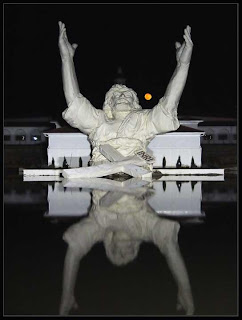
With respect to the latter question, and to serve as an example of this potential, I just ran a Google search for "Touchdown Jesus" and found, among others, the notorious bust-statue of Jesus in northern Cincinnati--which can be seen here:

(To others in the Cincinnati area, this statue is also known as the "Mashed Potato Jesus").

While it is true that such visible creations are not indicative of the way many of us operate within Christianity; it may be safe to say that these creations do color the ways in which the outside world views Christianity. The question then becomes: are such colorings how we want Christianity to be known and remembered?

Sunday, October 07, 2007

Halo in Youth Group?

Hey everyone - sorry I haven't posted much lately.  I'll get back to regular posting soon - things have been pretty busy over the past week or two, but I think they're slowing down a little bit.

In the meantime, some of you may be interested in this discussion on biblical scholar Ben Witherington's blog.  I know some of you that read are Christians who also enjoy the game Halo specifically, or even video games in general.  If so, you may be interested in the post and the discussion.  Ben is questioning the use of Halo (and by extension, I think, some other video games as well) at youth group events, and seems to me to be questioning whether its ok to play the game at all as a Christian (although I don't want to put words in his mouth - that side of the discussion seems to be implicit in the conversation).  I'd be interested to hear what you think - its turning into a good discussion so far.

If you know me, you probably know I've enjoyed the Halo franchise for years, and am particularly enjoying the third installment, which came out almost 2 weeks ago.

Thursday, August 30, 2007

American Idol? In a Church?


Many of you know that I am the Adult Ministries Pastor at StoneBridge Christian Church in Omaha, Nebraska.  Those who have known me for a while know that this was a bit of a change of focus for me - initially I imagined myself as a seminary professor rather than a pastor in a local church.  But I've been doing this job for about 5 months now and I love it.  I love this church and their commitment to reach people who don't know Jesus and disciple those who do.  I love being part of a staff that is absolutely committed to pursuing this goal with excellence, and is willing to try new ways of reaching out to the people in our community.  And I love the people in this congregation - their desire to minister to lost and hurting people, and willingness to devote their time and energy to the ministries of this church in service to the Kingdom of God have humbled and moved me more times than I can count.

So I got a little defensive when we ran across a blog post that seemed critical of what we were trying to do.  The author of the blog, Brandon, seems like a genuinely nice guy.  He says he never criticized what we do, and I think he sincerely means that.  He said he simply wants to ask questions.  Fair enough.  Although I can't help but think that the title of his post ("A Church is Making Idols"), coupled with his assertion that what we were doing is weird, and the fact that several people posted completely negative reactions and Brandon never responded to those reactions until we discovered the blog and posted a defense, amounts to a pretty critical take on things.  Having said that, our interactions with Brandon on his blog have been positive, and he's asked some valid questions, so I don't want to belabor this point.

So here's the issue itself.  We had a former American Idol contestant, Heather Cox, perform a concert at our church on a Saturday night.  She also led a forum that morning where people could hear about her experience on the show, as well as receive pointers on how to audition (American Idol held auditions in Omaha a week later).  As a part of the audition forum, people had a chance to perform, and the best performers were given the opportunity to perform at Heather's concert that night.  Heather is a young Christian woman, and this was an opportunity for people to hear a Christian perspective from someone involved with a TV show that has become a cultural phenomenon.

These events acted as a lead-in to a sermon series on American Idols that began the next day.  The series used the show as a springboard to move deeper into the Bible and see what it has to say about four things Americans have a tendency to idolize: popularity, beauty, money and power.

My question to you is: do you think this is weird?  That is the question posed by Brandon on his blog.  You can see the responses to his question at the link above, as well as my explanation of why we do events like these.  The short version is, we want to bring the community into our church, with the hope that they'll like what they see or hear and return.  I believe pretty firmly that every event we hold does not have to include an in-depth discussion of the Bible - sometimes we just want to connect with people in our community in a non-threatening way.  And I'm disappointed that some people (like several of the commenters on Brandon's blog) are so willing to make snap judgments about churches that make an attempt to be culturally relevant.  When did "relevant" become a dirty word in the church, anyway?

PS - Here's a link to another church member's blog on this topic.

Africa: How do we Respond?

I strongly urge everyone reading this blog to read these two articles - Jubilee: A Sabbath from Suffering and Bearing Witness.  Both deal with problems in Africa and other third world countries.  I found myself both moved and convicted as I read each article - moved by the very human faces they put on the problems (especially the second article) and convicted because I feel like I need to do something.  Problems like debt relief and HIV seem so big - and I'm not really sure what it is that I can and should do.  But the more I read about these issues, the more I think I need to do something.

Why do I feel such a great need to act?  Because more and more I realize that the way we live in the U.S., and the politcies made by the politicians that we elect, has a great effect on people in third world countries.  Our extraordinarily high levels of consumption, when coupled with trade agreements that favor wealthier nations (see this article on how trade agreements often work), have an effect on poor children in Africa who don't have enough to eat.  Our willingness as a country to forgive debt that should never have been incurred in the first place has an effect on mothers and fathers trying to make a better life for their children.

I'm new to many of these issues, and I realize that there are different sides to every issue.  Economics, global trade, HIV in Africa - these are enormously complicated issues - but I'm convinced I need to learn more.  I'd love to know what all of you think.

Wednesday, August 29, 2007

Optical Intercourse a/k/a Making Eye Babies


This is a rather short post only because a mention of this article actually made it into my law school criminal law text book. While discussing the importance that criminal laws provide notice to the public on what kind of conduct is criminal, thereby giving people the opportunity to conform their behavior appropriately, the case book editors noted an incident at Pensacola Christian College. Apparently, a female student was disciplined for engaging in "optical intercourse" or "making eye babies" with a member of the opposite sex. The case book then challenged us, without further details, to imagine what such an offense might be.

Putting aside the absurdity that is Pensacola Christian College (see the article for further details as well as an explanation of the offense mentioned above), it bothers me to think what will happen to some of these students when they have to face the real world. Additionally, it bothers me that this is the public impression the school is giving of what Christians are like. And if one doubts that the public is seeing this... remember, it has made it into my textbook.

PS: I pull the associated photo from PCC's website. I wonder if that guy is engaging in some optical intercourse...?

Thursday, August 23, 2007

Jesus and the Neighbor 2

Since I'm titling this series "Jesus and the Neighbor," it makes sense to look first at the passage where Jesus defines "neighbor."  In Luke 10:25-37 Jesus addresses this question: "Who is my neighbor?"

A lawyer asks Jesus how to inherit eternal life, and Jesus affirms that he should observe the two "greatest" commandments - love God and love your neighbor.  The lawyer, in an effort to determine the bare minimum he can do to be "saved," asks who he should consider his neighbor.

Jesus responds with a story.  It's probably familiar to everyone, but just in case I'll summarize it.  A Jewish man is beaten, robbed, and left for dead on the side of the road, and several religious leaders pass him by without helping him.  Finally a Samaritan stops, bandages the Jewish man's wounds, takes him to an inn, and pays for his care.  After telling this story, Jesus asks, "Who was a neighbor to the beaten man?"  The obvious response is the Samaritan - and Jesus tells the lawyer, "Go and do likewise."

First, a historical note.  From a Jewish perspective this story would have been shocking.  Samaritans and Jews did not get along.  At all.  There was a significant amount of animosity between the two groups, to the point that they avoided any association with one another.

What is most significant about this parable is that it really does not answer the lawyer's question: "Who is my neighbor?"  The lawyer was attempting to limit the circle of people he was responsible to help.  Jesus effortlessly correct the question - the appropriate question is not "who is my neighbor?" but "who can I be a neighbor to?"  Jesus does so by choosing the most unlikely person to help the man who had been robbed (the Samaritan), after the most likely people (Jewish religious leaders) and already passed him by.  Despite the hatred that both men would have felt toward the other, the Samaritan helps someone who by anyone's definition would have been outside the group of people who might be called his "neighbors."

Who, then, is our neighbor?  Anyone who is in need.  That is the way Jesus answers the question; it is the way we must answer it as well.

Sunday, August 19, 2007

Just for fun

This post will be (somewhat) out of the norm for this blog, but hey . . . it's a weekend. This will also be, to some readers' surprise, a short post. It will be a quick summary, then a question, and then a follow-up comment.

The summary
Today, after church, my wife and I went to a local cafe for some brunch. While we were waiting for our name to be called, we were perusing the tables of books in front of the neighboring bookstore. In the midst of our searching, another couple past behind us and we caught only the question asked by the gentleman (see below).

The question
"What book or books would Jesus buy?"

The follow-up
My wife looked to me, once the couple had passed, and said with a pinch of humor, "Jesus wouldn't buy any books; he already knows everything." I responded in the opposite direction by saying, "I don't think the guy meant 'buy books for knowledge sake'; I think he meant, 'buy books that Jesus would find intriguing'."

This exchange revealed a controlling issue within interpretation. A single question was asked, and two different interpretations of that question immediately emerged. (I'm sure if we asked the gentleman what he meant, a third interpretation would have been revealed). But I would like to side-step that particular issue and open this same question up to the readers. Interpret the question however you like. My concern is how you would respond to the question: What book(s) would Jesus buy? (You can even throw in some examples if you wish).

Saturday, August 18, 2007

Cursing Your Enemies?

Biblical scholar Ben Witherington posted about this story on his blog - which brought it to my attention.  Apparently, this pastor has asked the people in his church to pray "imprecatory prayers" (modeled after the "imprecatory psalms") against two men who blew the whistle on his activities which violated the prohibition against churches (which are tax-exempt organizations) from using their influence to directly endorse political candidates.

What is an imprecatory psalm, you ask?  Good question!  Imprecatory psalms are psalms in which the author calls for God's wrath to come upon certain people.  There are several of these types of psalms in the Old Testament.  A couple of examples will help.  Psalm 109 (a psalm attributed to David himself) contains the following requests of God regarding an unnamed enemy:
"Let his days be few; let another take his office.  Let his children be fatherless and his wife a widow.  Let his children wander about and beg; and let them seek sustenance far from their ruined homes.  Let the creditor seize all that he has, and let strangers plunder the product of his labor." (Psa 109:8-11)
There's more, but that's enough to get the point across.  A second example, from Psalm 137, is even more shocking.  Speaking of the Edomites, the psalmist writes:
"O daughter of Babylon, doomed to destruction, happy is he who repays you for what you have done to us - he who seizes your infants and dashes them against the rocks." (Psa 137:8-9)
What are we to make of such sentiments?  Are they "God-ordained," an example for us to follow (as the pastor in the above referenced news story would have us believe)?  Absolutely not - to view these as examples of "godly" behavior would be to completely misunderstand these Psalms.  What we find in the Psalms is humanity in all its glory and its sinfulness - at its best and its worst.  In the imprecatory psalms the authors are expressing their anger and frustration to God, but it does not come out in ways that reflect God's will.  It does, however, show us that such feelings are at times natural.  However, that does not mean they are examples to follow.  But it can be a comfort to us to know that we are not the only ones who get angry - and to know that God understands such feelings.

Back to the story.  This pastor asked his congregation to pray for the deaths of the two heads of Americans United for the Separation of Church and State.  The reason?  Because he had publicly endorsed, on church letterhead, Republican candidate Mike Huckabee, and urged his church members to do the same, and they reported him to the IRS for doing so.  And they were right to report him.  Churches can lose their tax-exempt status for endorsing particular candidates, and they should.  It is an abuse of power for a Pastor to use his position to influence church members' votes.

The pastor's call for his followers to pray for the deaths of these two men shows a fundamental misunderstanding of the imprecatory psalms.  It also runs counter to Jesus' own teachings in the gospels, where he commanded his followers to pray for their enemies (which does not include praying for their death).  Additionally, at the most basic level Jesus taught his followers to love other people - the subject of my "Jesus and the Neighbor" series of posts.  It is tragic when Christians miss the point of Jesus' teaching so completely that their actions truly become a perversion of the gospel, twisted beyond all recognition.

Friday, August 17, 2007

World's Largest Cross?


Well this seems pointless - but nevertheless is amusing for its absurdity. This group's goal is to build the world's largest cross in Nazareth with a church in the middle. Here's their goal, from the website:
The Nazareth Cross Project aims to build the world’s largest and most impressive cross, standing at 60 meters tall, housing a magnificent church in its center. The cross will be decorated by some 7.2 million brilliant mosaic tiles of varying sizes, each one with a personal engraving. These tiles will be made of stone from Nazareth,or platinum, silver or gold.
You can go to the site and give money towards the cross - definitely money well spent!

If you've lived in Cincinnati, you'll note the potential similarity to everyone's favorite giant, useless religious artifact: Touchdown Jesus!


UPDATE: Here's a picture of the 60-foot cross in Texas, pointed out by Dave.

Saturday, August 11, 2007

Jesus & the Neighbor 1

I'm going to start a new series of occasional blog posts.  The impetus for the series came out of a series of emails between myself and a couple friends about an email forward that touched on political issues.  I used to consider myself strongly conservative from a political perspective, but that's changed over the past 5 years - if you've talked to me about politics, you know that I would consider myself a political "moderate" or "independent."  I'm absolutely convinced that neither the Republicans or the Democrats is the "Christian" party, and that both parties have elements that are worth supporting, and elements that are problematic from a Christian perspective.  As a Christian, I believe my role in politics is to try and have a "prophetic voice," calling both parties to account when they advocate policies that cause our country to act in unjust or immoral ways.

This series is not about politics though.  As we emailed about our thoughts on this email forward, I expressed that everything about my political views that has changed over the years has done so as a result of my reflections on the Bible's teachings about justice, standing up for the oppressed and downtrodden, and especially Jesus' teaching about how we're supposed to treat other people.  In order to explain this idea better, I'm starting this blog series to explore different gospel texts in which Jesus tells us something about how we should treat people in the Kingdom of God.

I'm throwing in this term "Kingdom of God," which I believe is an important one.  I would suggest that everything Jesus said and did was an attempt to reveal the Kingdom of God, and define "Kingdom of God" very simply: living as if God is in charge.  Thus, anytime we behave in a way that acknowledges God's sovereignty, we are living in the Kingdom of God.  It is pretty common to speak of the Kingdom as having an already-but-not-yet tension - what this means is that the Kingdom of God is present now (insofar as we live as if God is in charge), but that it will not be fully present until Jesus' return and the restoration of heaven and earth.  However, this should not prevent us from doing all we can to make the Kingdom more fully present in this life - in fact, I believe that we are called to do exactly that.

So, a part of Jesus' teaching on the Kingdom of God is how we treat other people.  That is what this series will be about.  Next post will start with a foundational text that is familiar to many - the parable of the Good Samaritan, in which Jesus responds to the question, "Who is my neighbor?"

Friday, August 03, 2007

Religion Beat Becomes a Test of Faith

I highly recommend checking out this article,* written by the former religion reporter for the L.A. Times.  It is a well-written, moving account of his spiritual journey, which began as an adult converted in an evangelical church, and has sadly arrived at the current point where he is not sure he believes in God.  The reason?  Here are a couple excerpts:

Regarding the Catholic sex abuse scandal:
"Many of these victims were molested by priests with a history of abusing children.  But the bishops routinely sent these clerics to another parish, and bullied or conned the victims and their families into silence.  The police were almost never called.  In at least a few instances, bishops encouraged molesting priests to flee the country to escape prosecution."
Regarding the Trinity Broadcasting Network (TBN):
"Some of the nation's most powerful pastors - including Billy Graham, Robert H. Schuller and Greg Laurie - appear on the Trinity Broadcasting Network, benefiting from TBN's worldwide reach while looking past the network's reliance on the "prosperity gospel" to fuel its growth."
Regarding Packy, an Eskimo who was sexually abused by a Catholic missionary - Packy is now in prison:
'A lot of people make fun of me, asking if the Virgin Mary is going to rescue me,' Packy said.  'Well, I've gotten helped more times from the Virgin Mary through intercession than from anyone else.  I won't stop.  My children need my prayers.'  Tears spilled from his eyes.  Packy's faith, though severely tested, had survived.  I looked at him with envy.  Where he found comfort, I was finding emptiness."
As I read the article I was struck by how damaging the sinful actions of Christian leaders can be.  Please don't misconstrue me - Christian leaders are human, and will make mistakes, and its a mistake to place them on any sort of pedestal.  At the same time, their actions can have very real consequences in people's lives, made stronger by their position as a religious authority figure.  Likewise, as I read his words about TBN, I wondered about the complicity of religious leaders who, while certainly not teaching the prosperity gospel, choose not to speak against it - indeed, appear on the station at various times.

My heart breaks for people like this reporter, whose faith has been so severely damaged by the actions of other Christians that he may never regain it.  I pray that my actions will never affect someone in a similar way.  And it makes me more committed to the idea of "reclaiming Christianity" that I mentioned here.  There are so many poor examples of what it means to be a Christian - sometimes from leaders that should know better, and sometimes from Christians who do the best they can with the knowledge they have.  Regardless, we often are not good followers of Jesus.  I know we can do better.

* The article does require registration with the L.A. Times - its free though, and the article is worth it.

Sunday, July 29, 2007

Christians United for Israel


Biblical scholar Ben Witherington posted recently on his blog about this disturbing video.  The video contains footage of a recent conference put on by Christians United for Israel, a political lobbyist group founded by John Hagee, a Christian televangelist who is well-known for his dispensational premillenialist interpretation of the "end times."  I tend to think that people will believe what they're going to believe about Revelation and the end times, and while I have my own views that I'm more than willing to discuss, I do not think it is a salvation issue, and therefore is not something I emphasize greatly.  I think it has become far too divisive an issue in many instances.

Having said that, I think that Hagee's particular brand of end times belief is dangerous.  Many of the comments in the video disturb me greatly, although in fairness it should be noted that the video is obviously assembled by someone who strongly dislikes the organization.  Witherington gives the following "top five" things about the video that he finds problematic:
1.  The Anti-Christ will be a person who will seek to make peace between the Arabs/Palestinians and the Jews;

2.  Armaggedon is something to look forward to, when we will have 'the cleansing of the earth';

3.  U.S. support for Israel should be unconditional, regardless of how they treat Palestinian Christians;

4.  If we want to participate in the second coming of Jesus, then we have to unconditionally support Israel from now until then, regardless of their policies or behaviors, otherwise we miss out on the parousia blessing;

5.  It's a Biblical idea to have a pre-emptive strike on Iran before they cause more trouble for Israel.
I really don't want to step on anyone's toes here.  At the same time, these ideas have very real ramifications in today's world that need to be addressed.  Christians United for Israel actively lobbies Congress for a) increased territory for Israel, and b) a unilateral, pre-emptive strike on Iran, based on the fear that they will cause problems for Israel.  I'll state unequivocally that I find this to be an immoral proposition.  Even within the Christian "just-war" tradition, there is little to no leeway in the idea of a "pre-emptive strike."  To suggest such a strike because of the fear they will cause problems for Israel, knowing that any war will inevitably lead to the death of many innocent civilians, not to mention soldiers, shows shockingly little regard for life, especially Muslim life (for the record, I also don't agree, as people in the video state, that Muslims are our "enemies" - our enemies are "not of flesh and blood" [Eph 6:12]).  From a Christian perspective, however, all life is valuable--Israeli life should not be considered more worth protecting than Arab life.

I do believe that these ideas are based on shaky theology.  Paul seems clear that the church is the "new Israel."  While I fully believe that the modern-day Israel has every right to exist, it no longer fulfills the role of God's "chosen people" - the Church universal, made up of both Jews and Gentiles, has assumed that role.  Again, I strongly believe that end times theology is not a salvation issue and therefore people should have great freedom in what they believe.  However, when that freedom leads to such potentially dire consequences for so many people, I think it is important to speak up.  And I'm frightened that so many Christians can so easily call for war on Iran, with the unavoidable loss of life that would accompany it.

Thursday, July 26, 2007

Discussing Harry Potter


I love that the Church of England, rather than outright condemning the Harry Potter books as somehow promoting witchcraft and the occult (as if the "magic" in Harry Potter and witchcraft in the Bible were remotely the same), has chosen to release a study guide that uses Harry Potter as a starting point to discuss Christian themes.  Granted - such study guides can be done quite poorly, and I haven't seen this one.  Still, I think this is a much more healthy and constructive approach to the Harry Potter phenomenon than Christians condemning literature simply because it involves some form of "magic."
"Jesus used storytelling to engage and challenge his listeners," [Diocese of Oxford Bishop John] Pritchard noted.  "There's nothing better than a good story to make people think, and there's plenty in the Harry Potter books to make young people think about the choices they make in their everyday lives and their place in the world."

Wednesday, July 25, 2007

Jesus Action Figure?


Umm . . . so Wal-Mart is apparently set to begin selling Jesus action figures - along with other "faith-based toys" (think Samson and Daniel with a Lion's Den).  They'll only sell them in 420 stores though - only the stores that "sell a lot of Bibles."

I realize that some Christian parents want to give their children "wholesome" action figures, but seriously - what do they think their kids are doing with them?  I seriously doubt they're re-enacting Jesus healing the blind man . . . 

My favorite comment reacting to this news?  "Go ahead.  Cast the first stone!"  Hopefully they'll include that on the packaging.

Do Some Evangelical Leaders Perpetuate Cycles of Domestic Violence?

That's a pretty sobering question, isn't it?  The contention of this article is that some evangelical leaders (James Dobson and John MacArthur) help perpetuate domestic violence and endanger victims through their teaching.  I highly recommend reading the article - if the author's contentions are true, its pretty disturbing.  Here's one of the relevant quotes from the article regarding John MacArthur:
Andersen also takes on MacArthur: According to a tape titled Bible Questions and Answers Part 16, a member of Grace Community Church asked MacArthur how a Christian woman should react “and deal with being a battered wife.”

MacArthur’s answer contained “some very dangerous advice to battered wives. He said divorce is not an option to a battered wife, because the Bible doesn’t permit it.” While saying that it was okay “for the wife to get away while the pressure was on” it was with the understanding that she would return. “He warned wives to be very careful that they were not provoking the abusive situations. Because, he said, that was very often the problem.”
It seems at best irresponsible to indicate that wives are responsible for the abuse they endure (or husbands if the situation is reversed). Even if some case could be made that they were provoking their husbands, there is never an excuse for domestic violence. Ever. And if MacArthur is correctly represented here, the language he uses could easily be seen as justifying the abuse, whether or not that is his intention.

Religious leaders need to think deeply about the implications of the things they teach. I'm confident neither Dobson or MacArthur would ever want to condone, justify, or in any way help perpetuate domestic abuse. But that doesn't mean that the things they teach are not responsible for exactly those things.

Read the article - what do you think?

Tuesday, July 24, 2007

Bush, Freedom and Theology


Today I ran across this interesting post on Christianity Today's blog.  It's worth reading the actual post, but basically its about a backlash Bush has experienced lately regarding a recent comment he made about freedom.  Here's the quote:
The other debate is whether or not it is a hopeless venture to encourage the spread of liberty. Most of you all around this table are much better historians than I am. And people have said, you know, this is Wilsonian, it's hopelessly idealistic. One, it is idealistic, to this extent: It's idealistic to believe people long to be free. And nothing will change my belief. I come at it many different ways. Really not primarily from a political science perspective, frankly; it's more of a theological perspective. I do believe there is an Almighty, and I believe a gift of that Almighty to all is freedom. And I will tell you that is a principle that no one can convince me that doesn't exist.
A number of prominent bloggers have taken issue with this statement (Rich Lowry from National Review Online, Rod Dreher from Beliefnet, and Andrew Sullivan and Ross Douthat from the Atlantic Online).  While I might quibble with individual points in their arguments, I also am quite disturbed by the quote.  Some people don't think that a politician's religious beliefs should affect their policy decisions--I'm not one of those people.  My religious beliefs inform every decision I make, and I'm not sure why it should be different for politicians.  Unless one was to compartmentalize their beliefs as something separate from other areas of their life, I'm not sure how they could keep their religious beliefs from influencing their decisions.  With that said, I think there is a fine line to be walked--in a democracy and a pluralistic society, there are necessarily other voices besides the Christian voice that need to be heard.  Still, I believe that the Christian voice needs to be heard.

But I digress.  While I believe a politician's religious beliefs will inevitably influence their decisions, I find Bush's statement above highly suspect from a theological perspective.  Bush's claim seems to be that, because the gift of God to all is "freedom," this means that America should export its particular brand of freedom to the rest of the world.  The implication is that western democracy is somehow a part of the "freedom" which is God's gift.  And you simply cannot defend that position from the biblical text.  The "freedom" associated with being a Christian is freedom from slavery to sin--it is emphatically not political freedom.  If it was, Jesus would surely have worked for the overthrow of the Roman empire--instead, he tried to defuse Jewish nationalistic fervor which was focused on revolt against Rome.

Of course, this does not mean that it is necessarily bad to bring western democracy to other nations (although I think we need to be very careful in assuming that everyone else in the world does or should want our political system).  It does mean, however, that the spread of western democracy cannot be justified on the basis of Bush's vague "theology of freedom."  His attempt to do so completely misrepresents the kind of "freedom" Christ died to provide.

Wednesday, July 11, 2007

Christians: Revolutionaries and Barbarians or Not?

My wife is going to camp next week with her home church as an adult volunteer. One of the books they are reading in preparation for the week is "The Barbarian Way" by Erwin McManus. First, I have not read the book, so the following is not a critique (though my wife does not seem very impressed so far). Instead, I would like to point out the notable trend in Christian discourse to adopt the vocabulary of war as a means of discussing the role of Christians in the world. This includes phrases like "be a solider for Christ" or references to Jesus as a "revolutionary" along with admonishments to follow Him as revolutionaries. The other day I watched a video of a presentation by Dr. Alan Keyes where I noted his frequent references to the war against the family and the war against religious freedom (there were a number of notable points in this presentation which I plan to address in a future post).

The question this raises is whether this trend is a positive one. Are Christians meant to be "barbarians" or "revolutionaries?" Certainly many of those who adopt these words hijack and nuance their meanings for specific purposes, but the question remains whether one can completely redefine words which already have meaning within our social discourse. As July 4, Independence Day, just past, it reminds that the word "revolutionary" has great significance in the American tradition. The American Revolution was a violent and bloody affair. Most revolutions are. Further, the language of war suggests fighting, strife, and death. Jesus' call, however, is different. While He was clear that violence against his followers would be a real possibility, perhaps even a likely one, He was equally clear that they were not to respond in kind.

So are we at war? Should we be revolutionaries or barbarian? The answer is both "yes" and "no." As is made plain by the words of Paul, if Christians are at war, it is a spiritual one and not one against other people. The problem then, is that when we talk about our various "Christian" causes (e.g. abortion, gay rights, marriage and the family, posting of the Ten Commandments, etc.) using the language of war, it tends to be groups of people (e.g. "those liberals") or organizations (e.g. the ACLU) we reference. Is this truly reflective of the kind of grace under which we live? Is this truly reflective of the salvation being offered to those people and the members of those organizations?

Tuesday, July 03, 2007

Conservapedia

So . . . ummm . . . a friend brought this to my attention. I'm curious what you guys think. I'll go out on a limb here and say what I think too.

Sites like this (and GodTube - I'm sure I could find other examples if I looked) frustrate me a bit . . . mostly for one reason. There seems to be a preoccupation in some Christian circles with creating a Christian subculture that acts as a parallel culture, where Christians can presumably feel safe and be themselves. Unfortunately, what usually occurs is that Christians become comfortable within this parallel culture and prefer to stay there. I'm not sure how this response fits with Jesus' admonition that Christians should be "salt and light" within society (see Matt 5:13-16).

My understanding of why Conservapedia was created comes from this article, in which the author says that wikipedia is "riddled with liberal bias." Therefore he felt the need to start a new version. I would suggest that perhaps a better approach, and one which takes Jesus' admonition into account, would be to work to add another perspective to wikipedia.

I would also, however, question the particular perspective offered by at least some of the articles on Conservapedia, which make claims that frankly would not be allowed on wikipedia (and with good reason). The site purports to be "the trustworthy encyclopedia," and one that "[has] certain principles that we adhere to, and we are up-front about them. Beyond that we welcome the facts." However, some of the articles noted in the news article linked above are disturbing. Here are two examples for those who haven't read the article:

1. Femininity is the quality of being "soft spoken, childlike, gentle, pretty, willowy, submissive."
2. Hillary Clinton may suffer from "a psychological condition that would raise questions about her fitness for office" - "clinical narcissism."

It is worth noting that the creator of the site defends that article as "an objective, bias-free piece from a conservative perspective." I'm not sure what that means - there is nothing objective about those statements. They clearly come from a conservative perspective, and from a dangerous one at that - unsubstantiated claims of that sort could likely be considered slander. However, my main point is not to defend Hillary Clinton - it is to say that there seems to be a severe lack of self-awareness on the part of the site's creator, and the site itself. To claim objectivity for a site that obviously associates itself with a conservative political perspective is a problem - as would be claiming objectivity for a site from a liberal political perspective.

However, this is veering towards politics and that wasn't my intent with this post. My main point, and the question I pose to any readers, is this: Is the creation of this site the best course of action for someone who doesn't like wikipedia? Stated more broadly: Is the creation of a specifically Christian alternative the best response to something in society that does not meet Christian approval? I don't think so - I think the harder road is to work within society and culture to present a truly Christian perspective. The "I'll take my toys and go play in another sandbox" response benefits no one, and does not honor Jesus' admonition to be "salt and light."